
Hey fellow REIT investors! Welcome back to the channel. Today, I want to start with something that’s been keeping me glued to my screen lately: the 10-year US Treasury yield.
Why? For me, this chart is like my personal “fear index” for REIT investments. When the yield climbs, REIT prices usually take a hit. Since October 2024, things haven’t been looking good at all. Despite the US Fed cutting rates, which influences short-term yields, the 10-year US Treasury yield kept climbing relentlessly, reaching above 4.8% by mid-January 2025. That’s not exactly what a REIT investor like me and you wants to see!
But then, something happened that gave me hope. After mid-January, the yield started to drop steadily, and by 5th February, it had fallen to 4.42%. I remember thinking, “Finally! Some relief!”
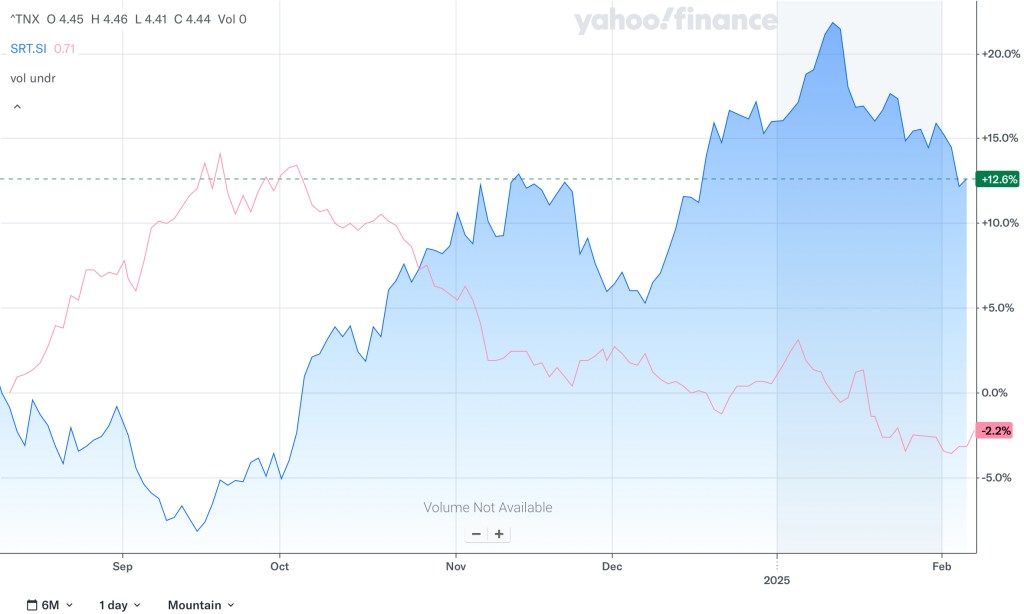
Unfortunately, my optimism didn’t last long. Just as I was starting to feel cautiously happy, the trend reversed again. The yield shot back up to 4.5%, and I found myself wondering: was that just a temporary blip, or are we heading for more pain?
Let’s take a step back and talk about what’s been happening and why this matters so much for REIT investors.
But first, let me remind you that this post is for informational purposes only and not financial advice. Always consult a licensed financial adviser to ensure your decisions align with your goals. And I hold REITs in my portfolio, but remember, what works for me might not work for you.
Alright, let’s get started!
What’s Been Happening with REITs and Yields?
As REIT investors, we’ve learned one thing the hard way over the past two years: interest rates matter, a lot. REITs are highly leveraged investments, with gearing levels typically around 40%, some as low as 30%, and one bold has even crossed the 50% regulatory limit.
Over the last two years, we’ve seen how rising interest rates can wreak havoc on REIT prices. Singapore REITs, as reflected by the C SOP iEdge Singapore REIT Leaders ETF, have fallen around 30% in total over the past 5 years. This is why October 2024 felt like a potential turning point—the Fed had finally started cutting rates, and investors were ready for REITs to stage a comeback.
But that comeback never really happened.
The 10-year Treasury yield, which is a key indicator of long-term investor sentiment, didn’t behave the way we expected. Normally, when the Fed cuts rates, long-term yields drop. Instead, the 10-year yield kept climbing, signaling that investors were still worried about inflation.
If you’re not familiar with the 10-year yield, think of it as a barometer for inflation expectations. When it rises, it puts pressure on REIT prices. By mid-January 2025, analysts were predicting it could break the 5% psychological level, which could bring even bigger market volatility.
That’s why I was so closely watching the trend. For me, the 10-year yield is both my personal fear index, and a forward indicator for REIT performance. The higher the yield goes, the greater my fear for how my REITs will perform. Rising yields not only spook investors, dragging REIT prices down, but they also eventually translate into higher interest expenses, which can chip away at distributions. So when the yield started falling in late January, I felt a bit of relief, thinking we might finally see some recovery.
But then came Friday, 7 February, and sentiments changed.
What Happened To Reverse the 10-Year Downward Trend
On 7 February, three things happened that sent the 10-year US Treasury yield soaring again.
First, the University of Michigan’s consumer survey showed that respondents now expect one-year inflation to hit 4.3%, a full 100 basis points higher than the previous month’s reading. That’s a massive jump, and it immediately caught the market’s attention.
Second, the January jobs report showed higher-than-expected hourly earnings growth. A stronger economy sounds like good news, right? Well, not exactly. A hot labor market often leads to higher inflation because people have more spending power.
And finally, the last straw: the US announced more tariffs on key trading partners. Most analysts agree that tariffs usually lead to higher prices for imported goods, adding even more pressure to inflation.
The result? The 10-year yield shot back up to 4.5%, reversing that nice downtrend and shaking this uncle’s newfound optimism.
Before we move on, if you’ve enjoyed the content so far, please leave me a ‘like’! That’s the encouragement for this uncle to continue bringing you REIT analyses and updates!
The Dividend Uncle’s Take: Where Does This Leave REITs?
So, what does this all mean for us as REIT investors? Is this reversal a temporary blip, or are we heading back into trouble?
Honestly? I wish I had a clear answer. If you were sitting across from me over a cup of kopi and asked me casually, I’d probably say I’m optimistic that this is just a blip. But at the same time, these are uncertain times, and there are reasons to stay cautious.
The biggest reason for my hesitation? The US economy is just too strong.
I know that sounds like a strange problem to have, but hear me out. When the stock market does well, people feel richer—that’s called the wealth effect. And boy, has the US stock market done well! The S&P 500 has grown more than 20% annually over the past two years, making people feel confident and willing to spend.
Combine that with a strong jobs market and the uncertainty surrounding future tariff policies, and you’ve got a recipe for continued volatility ahead.
So, where does this leave REITs? Well, I wish I could tell you they’ll recover by the end of the year, but with so many moving parts, I can only promise you one thing—stay with me here on The Dividend Uncle channel. I’ll keep monitoring the situation closely, and whenever something big happens, I’ll be back to share my thoughts and updates.
For now, keep calm, have a good kopi, and remember—investing is a marathon, not a sprint. Thanks for joining me today, and if you found this discussion helpful, give it a like and subscribe. Until next time, happy investing!

 The Dividend Uncle
Leave a reply to REITs Falling For The Wrong Reason – 4 REITs Riding the Interest Rate Trend! – The Dividend Uncle’s Take Cancel reply