
Executive Summary
Hospitality REITs have traditionally occupied a unique position within the Singapore REIT universe. Unlike office, retail or industrial landlords that benefit from contracted leases, hotels effectively reset their revenue every day, making earnings highly sensitive to travel demand, room rates and economic cycles. This inherent volatility has historically led many income investors to treat the sector as a tactical recovery play rather than a long-term core holding. However, CapitaLand Ascott Trust or CLAS (SGX: HMN) has spent the past several years reshaping its portfolio in ways that suggest management is pursuing a different objective: reducing reliance on any single source of hospitality demand while preserving exposure to long-term travel growth.
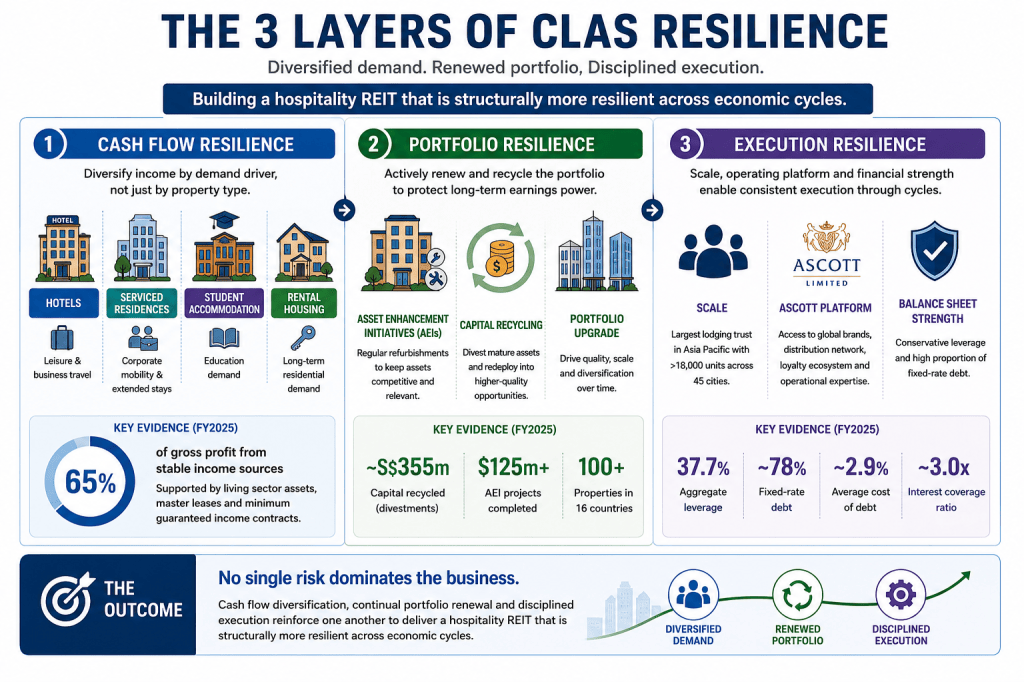
Rather than simply expanding its hotel portfolio, CLAS has deliberately increased exposure to serviced residences, rental housing and student accommodation, complemented by active capital recycling, asset enhancement initiatives (AEIs) and disciplined balance sheet management. Viewed collectively, these initiatives reveal a broader strategy centred on improving business resilience rather than maximising near-term earnings. The result is a hospitality REIT that increasingly resembles a diversified lodging platform capable of navigating market cycles with greater stability.
Looking Beyond Hotels: Diversifying Demand Rather Than Property Types
At the end of FY2025, CLAS owned 103 properties comprising more than 18,000 units across 45 cities in 16 countries, with total assets of approximately S$8.9 billion, making it the largest lodging trust in Asia Pacific. Yet the portfolio’s diversification extends beyond geography or asset count.
The more meaningful distinction lies in the diversity of demand drivers underpinning the portfolio.
Hotels remain the trust’s primary earnings engine, benefiting directly from recovering international travel and offering significant operational leverage through dynamic room pricing. Unlike traditional commercial leases, hotel room rates can be adjusted daily, allowing revenue to respond quickly when demand strengthens. The trade-off, however, is greater earnings volatility whenever travel weakens.
To reduce dependence on this cyclical income stream, management has expanded into accommodation formats driven by fundamentally different sources of demand.
Serviced residences cater primarily to corporate relocations, project teams, expatriates and families requiring extended stays. These guests typically book for weeks or months rather than nights, improving booking visibility and occupancy stability relative to traditional hotels.
Student accommodation introduces another independent demand driver. University enrolments are generally less correlated with tourism cycles, providing recurring occupancy supported by academic calendars rather than discretionary travel.
Meanwhile, Japanese rental housing contributes exposure to residential demand—a market driven by long-term housing needs instead of visitor arrivals. Tokyo’s structural housing shortage, stable occupancy and attractive freehold opportunities have made it an increasingly important component of CLAS’ long-term strategy.
Taken together, these assets diversify the reasons people occupy CLAS properties rather than simply diversifying the properties themselves. This distinction is subtle but strategically important because different demand drivers rarely weaken simultaneously.
By FY2025, approximately 65% of CLAS’ gross profit was generated from relatively stable income sources, supported by living-sector assets, master leases and minimum guaranteed income (MGI) contracts. Instead of eliminating hospitality volatility, management has progressively reduced the trust’s reliance on it.
Portfolio Renewal: Protecting Long-Term Earnings Power
Hospitality assets differ from most real estate sectors because they continuously compete for guests rather than simply collecting contracted rent.
Guest expectations evolve rapidly. Room designs become dated, technology changes and new competitors continually enter the market. Without periodic refurbishment, even well-located hotels risk losing pricing power over time.
Consequently, Asset Enhancement Initiatives (AEIs) should not be viewed as discretionary spending but as essential investments to preserve future cash flow generation.
CLAS has adopted an active portfolio renewal strategy that combines AEIs with disciplined capital recycling. During FY2025, the trust completed major refurbishment projects in Paris and Seoul while simultaneously divesting mature assets in China and Japan above book value and redeploying capital into higher-quality opportunities, including additional rental housing acquisitions in Greater Tokyo.
Rather than treating acquisitions, divestments and refurbishments as isolated events, management appears to be executing a continuous process of portfolio optimisation.
This approach inevitably creates temporary earnings disruption.
FY2025 Distribution Per Stapled Security (DPS) remained stable at 6.10 Singapore cents, although recurring Core DPS was approximately 5.35 cents, with the difference largely supported by realised gains from divestments during the year. While some investors may view this negatively, context matters.
Hotels undergoing refurbishment naturally experience temporary earnings declines while rooms remain unavailable. Using realised gains to smooth distributions during these transition periods differs fundamentally from relying on asset sales to support a structurally weak business.
The more meaningful measure of success will be whether renovated properties subsequently deliver stronger occupancy, higher Average Daily Rates (ADR), improved Revenue per Available Unit (RevPAU) and sustainable recovery in recurring distributions over the next several years.
Scale Strengthens Execution
Executing a continually evolving portfolio requires more than a sound strategy—it demands operational capability.
Scale provides CLAS with advantages that extend beyond simply owning more assets.
With over 100 properties spread across multiple markets, refurbishment schedules can be staggered, acquisitions diversified across regions and individual property disruptions diluted across the broader portfolio. No single hotel determines the trust’s overall performance.
Equally important is CLAS’ integration within The Ascott Limited, one of the world’s largest lodging operators. The operating platform provides recognised hospitality brands, global corporate relationships, revenue management systems and local operating expertise that would be difficult for smaller hospitality REITs to replicate independently.
Financial flexibility further supports execution.
At FY2025, aggregate leverage stood at 37.7%, approximately 78% of borrowings were on fixed interest rates, average borrowing costs remained around 2.9%, while interest coverage was approximately 3.0 times. These metrics position CLAS with sufficient financial capacity to continue funding AEIs and acquisitions despite a higher interest-rate environment.
Although perpetual securities increase total financing obligations modestly when considered alongside debt, adjusted leverage remains around 39%, still comfortably below regulatory limits and consistent with a conservatively financed balance sheet.
Key Operating Characteristics
| Metric | FY2025 |
|---|---|
| Properties | 103 |
| Assets Under Management | ~S$8.9 billion |
| Countries | 16 |
| Cities | 45 |
| Stable Gross Profit Contribution | ~65% |
| Aggregate Leverage | 37.7% |
| Fixed-Rate Debt | ~78% |
| Average Cost of Debt | ~2.9% |
| Interest Coverage Ratio | ~3.0× |
Key Risks & Mitigating Factors
- Travel demand remains cyclical. Hotels continue to experience earnings volatility during economic slowdowns, although exposure to serviced residences, rental housing and student accommodation reduces dependence on tourism alone.
- Asset enhancement initiatives temporarily reduce earnings. Refurbishment works affect short-term distributions but aim to strengthen occupancy, pricing power and long-term asset values following completion.
- Currency translation remains a meaningful risk. Japan has become an increasingly important market, and prolonged weakness in the Japanese Yen can reduce reported Singapore-dollar earnings despite healthy underlying operating performance.
- Higher-for-longer interest rates could increase financing costs. However, the predominately fixed-rate debt profile and moderate leverage provide meaningful protection against immediate refinancing pressures.
The Dividend Uncle Research View
The investment case for CLAS is no longer centred solely on the recovery of global tourism. Instead, management has spent several years redesigning the business around three complementary pillars: diversified demand drivers, continual portfolio renewal and disciplined execution.
While hospitality earnings will always remain cyclical, the trust is increasingly supported by accommodation formats whose performance depends on corporate mobility, education and residential demand rather than discretionary travel alone. Combined with active capital recycling and a well-managed balance sheet, these initiatives position CLAS as one of the more strategically diversified hospitality REITs within the Singapore market.
Rather than eliminating uncertainty, management has systematically reduced dependence on any single source of uncertainty. That distinction may prove increasingly valuable as investors navigate a more volatile macroeconomic environment.
How This Analysis Fits Within a Broader Research Framework
This article forms part of an ongoing research series examining Singapore-listed REITs and income-oriented investments through the lens of asset quality, income sustainability, capital discipline, and portfolio role. The objective is to provide structured, long-term analysis rather than commentary on short-term price movements.
Related Research
• Singapore REITs 2026 Guide
• Core–Satellite REIT Portfolio Framework
• Dividend Investing & Income ETFs — Structural Overview
Publication note: This article is intended for educational and informational purposes and reflects publicly available information as at the date of publication.


Leave a Reply