
Executive Summary
The expected S-REIT recovery in 2026 has been delayed rather than fundamentally invalidated. Renewed US inflation pushed back expectations for monetary easing and kept discount rates and refinancing costs elevated, even as underlying Singapore property fundamentals remained comparatively resilient. The central investment question for the second half is therefore not simply whether the Federal Reserve cuts rates, but whether disinflation becomes sufficiently durable for market yields and funding conditions to normalise.
Recent evidence has shifted that probability. US headline inflation moderated from 4.2% in May to 3.5% in June, energy pressures could ease if oil supply normalises, and the labour market is cooling. However, lower rates would affect S-REITs unevenly. Balance-sheet structure, refinancing schedules and operating resilience will determine which trusts translate a macro tailwind into stronger distributions and valuations.
The S-REIT Disconnect: Fundamentals vs. Discount Rates
S-REIT performance in the first half of 2026 illustrates an important distinction between property fundamentals and the price of capital.
The iEdge S-REIT Index declined approximately 6.3% on a price basis through June and around 3.9% after distributions, based on the underlying research material. Yet this weakness did not coincide with a broad collapse in Singapore property fundamentals. Occupancy remained healthy across many portfolios, rental reversions were positive in several sectors, and underlying property markets continued functioning relatively well.
The larger deterioration occurred in the macro environment.
US headline inflation accelerated to 4.2% year-on-year in May, forcing markets to reconsider the pace at which monetary conditions could normalise. By June, headline inflation had moderated to 3.5%, while core inflation eased to 2.6%. Energy remained the major distortion, rising 15.7% year-on-year even after falling 5.7% month-on-month.
For S-REITs, this created a valuation disconnect: operating cash flows were generally more resilient than the movement in required returns.
That distinction is critical because a reversal in interest-rate expectations could affect market valuations considerably faster than it affects reported distributions.
How Lower Rates Actually Flow Through to S-REITs
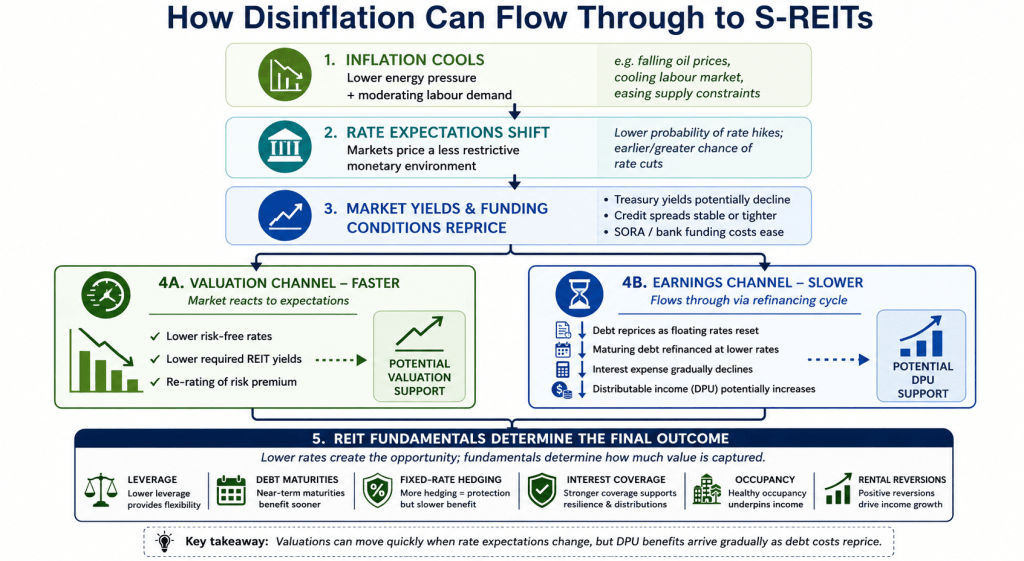
The interest-rate thesis operates through two separate transmission channels.
The valuation channel is relatively fast. When government bond yields rise, investors can obtain higher returns from lower-risk assets and generally demand greater compensation for holding REITs. Required REIT yields increase, putting pressure on unit prices even when property income remains stable.
If bond yields decline, that mechanism can operate in reverse. Financial markets can reprice REIT risk premiums before any improvement appears in financial statements.
The earnings channel is considerably slower.
REIT debt books typically combine fixed-rate borrowings, floating-rate debt and maturities spread across several years. Falling benchmark rates therefore do not immediately reduce financing costs. The benefit emerges progressively as floating debt reprices and maturing borrowings are refinanced.
This distinction explains why predicting the exact timing of the Federal Reserve’s next move is less important than identifying a sustained change in inflation and market-rate expectations.
The Macro Evidence Is Becoming More Balanced
The next question is whether the first stage of that transmission mechanism—sustained disinflation—is actually developing.
Three indicators have shifted in a more favourable direction.
First, headline US CPI fell from 4.2% in May to 3.5% in June, while core CPI moderated to 2.6%. The gap between headline and core inflation reinforces the unusually large contribution from energy to the 2026 inflation shock.
Second, the US Energy Information Administration expects the oil-market imbalance to reverse later this year. Global inventories fell by an estimated 5.1 million barrels per day in Q2 2026 and are forecast to decline another 2.2 million barrels per day in Q3. By Q4, however, inventories are projected to build by 2.7 million barrels per day as Middle Eastern supply recovers.
That shift underpins the EIA’s forecast for Brent crude to decline from an average US$103 per barrel in Q2 to approximately US$70 per barrel in Q4.
The exact price forecast is less important than the projected change in supply-demand conditions. A move from substantial inventory drawdowns to inventory accumulation would reduce one of the principal sources of the earlier energy shock, although geopolitical disruption remains a material uncertainty.
Third, US labour-market momentum is weakening. July nonfarm payrolls declined by 23,000, while earlier estimates for May and June were revised materially lower. The combined revisions removed 103,000 jobs from previous estimates.
A gradually cooling labour market could reduce wage and demand pressure without necessarily triggering a severe contraction. That would be the more constructive outcome for REITs: lower inflation and market rates without a corresponding collapse in tenant demand.
Taken together, these indicators do not establish that rates must fall. They do, however, make the inflation outlook more balanced than it appeared during the first half.
Three Paths for S-REITs in the Second Half of 2026
The stronger framework is therefore not a single interest-rate forecast, but three plausible macro paths.
Disinflationary Soft Landing
This is the most constructive combination for S-REITs.
Energy inflation moderates, labour demand cools without collapsing, and underlying economic activity remains sufficiently resilient to support tenant cash flows. As confidence in disinflation strengthens, bond yields and required REIT yields could decline before financing costs materially improve.
Under this scenario, valuation is likely to respond before DPU.
The subsequent earnings benefit would depend on individual debt maturity schedules and the speed at which lower market rates feed into refinancing costs.
Higher for Longer
Persistent inflation remains the principal constraint.
At its 29 July meeting, the Federal Reserve maintained the federal funds target range at 3.50–3.75%, while three FOMC members preferred a 25-basis-point increase. The Fed therefore remains some distance from validating a straightforward easing thesis.
If inflation remains sticky, funding relief would be pushed further out and required REIT yields could remain elevated.
In this environment, balance-sheet defence becomes more important than rate sensitivity. REITs with stronger interest coverage, moderate leverage, high fixed-rate debt proportions and limited near-term refinancing requirements should be relatively better insulated.
Growth Shock
The third scenario demonstrates why falling interest rates are not automatically positive for REITs.
If labour-market weakness accelerates into a broader economic contraction, monetary policy and market rates could decline faster. However, lower financing costs could then arrive alongside weaker consumer spending, softer office leasing, lower hospitality demand and more cautious corporate expansion.
The financing tailwind would therefore compete against deteriorating property-level cash flows.
For income investors, why rates are falling matters almost as much as how far they fall.
Which S-REITs Would Benefit Most From a Rate Pivot?
Even under the constructive scenario, lower rates would not produce uniform outcomes across the sector.
The first variable is the debt maturity profile. A REIT refinancing substantial borrowings over the next 12–24 months has greater sensitivity to changes in funding conditions than one whose maturities are further away.
The second is the fixed-versus-floating debt mix. Greater floating-rate exposure allows lower rates to flow into financing expenses more quickly, but it also creates greater vulnerability when rates rise. Conversely, extensive fixed-rate hedging provides protection during tightening cycles but delays the benefit of falling rates.
The third is aggregate leverage and interest coverage. Lower leverage provides greater balance-sheet flexibility, while stronger interest coverage reduces the probability that elevated financing costs constrain distributions or capital allocation.
These financial variables must then be considered alongside asset-level fundamentals. Occupancy, rental reversions, tenant quality and capital expenditure requirements ultimately determine whether financing savings translate into sustainable distributable income.
This creates an important distinction between rate sensitivity and investment quality.
A highly leveraged REIT with significant floating-rate debt might experience substantial earnings sensitivity when rates decline, but that does not automatically make it fundamentally stronger than a less rate-sensitive trust with superior assets, tenant demand and balance-sheet resilience.
Singapore Fundamentals Are the Counterweight
Singapore provides the other side of the S-REIT equation.
Domestic property conditions influence rental cash flows, while global financial conditions—particularly US rates—continue to influence funding costs and required investment returns.
MAS expects both Singapore Core Inflation and CPI-All Items inflation to average 1.5–2.5% in 2026. However, imported cost pressures have increased, and the latest MAS assessment expects core inflation to rise from July and remain elevated into early 2027.
The most constructive S-REIT scenario therefore requires more than falling US rates.
It requires softer global financing conditions alongside resilient Singapore property cash flows.
If occupancies and rental income remain healthy while global market yields decline, S-REITs could benefit simultaneously from a lower required return and eventual refinancing relief. If lower rates instead reflect severe global economic weakness, the improvement in financing conditions would have to be weighed against softer property fundamentals.
Key Risks & Mitigating Factors
- Oil prices remain geopolitically sensitive. Renewed supply disruption could prevent the projected Q4 inventory build; recovering production provides the principal mitigating factor.
- Inflation could remain above target. The Federal Reserve remains cautious and three July FOMC voters preferred tighter policy; softer core inflation and labour conditions nevertheless provide countervailing evidence.
- Labour weakness could become recessionary. Faster deterioration would weaken tenant demand even if rates decline; REITs with defensive assets and stronger occupancies would be relatively better positioned.
- Refinancing relief will be uneven and delayed. Fixed-rate hedges protect distributions during tightening cycles but slow the benefit when rates fall, making debt maturity schedules critical.
- A sector rerating does not eliminate security-specific risk. High leverage, weak rental reversions or deteriorating asset quality can overwhelm the benefit from lower market rates.
The Dividend Uncle Research View
The S-REIT outlook is best framed as a rate-transmission thesis rather than a rate-cut forecast. Falling energy pressure, moderating US inflation and a cooling labour market have increased the probability of a less restrictive medium-term rate environment, but the Federal Reserve has not yet validated that outcome. A disinflationary soft landing would provide the strongest combination of lower required yields, eventual refinancing relief and resilient property cash flows. Within the sector, balance-sheet strength and operating quality remain more important than simple rate sensitivity. Well-capitalised REITs with resilient assets can continue to serve a core defensive income role, while more leveraged or economically sensitive trusts remain higher-risk satellite exposures even under a more favourable rate environment.
How This Analysis Fits Within a Broader Research Framework
This article forms part of an ongoing research series examining Singapore-listed REITs and income-oriented investments through the lens of asset quality, income sustainability, capital discipline, and portfolio role. The objective is to provide structured, long-term analysis rather than commentary on short-term price movements.
Related Research
• Singapore REITs 2026 Guide
• Core–Satellite REIT Portfolio Framework
• Dividend Investing & Income ETFs — Structural Overview
Publication note: This article is intended for educational and informational purposes and reflects publicly available information as at the date of publication.
 The Dividend Uncle
Leave a comment