-
Continue reading →: Suntec REIT 1H 2026: Can Property Earnings Take Over From the Financing Recovery?
Executive Summary Suntec REIT’s (SGX: T82U) 1H 2026 distribution recovery was substantial: distributable income rose 25.5% year-on-year to S$116.5 million and DPU increased 24.8% to 3.936 cents. Yet net property income declined 0.3% to S$159.0 million. The apparent disconnect is central to the investment case because much of the improvement…
-
Continue reading →: S-REITs and the Interest-Rate Pivot: What Needs to Change for Rates to Become a Tailwind
Executive Summary The expected S-REIT recovery in 2026 has been delayed rather than fundamentally invalidated. Renewed US inflation pushed back expectations for monetary easing and kept discount rates and refinancing costs elevated, even as underlying Singapore property fundamentals remained comparatively resilient. The central investment question for the second half is…
-
 Continue reading →: Beyond the STI: What Q50’s Active Portfolio Reveals About Singapore’s Next 50
Executive Summary The launch of the CGS Fullgoal Singapore Next 50 Active ETF (SGX: Q50) creates a useful new lens through which to examine a relatively under-researched part of Singapore’s equity market. Rather than simply replicating the iEdge Singapore Next 50 Index, Q50 will hold 30–50 securities, maintain at least…
-
Continue reading →: Keppel DC REIT: Looking Beyond Rental Reversions to Reassess the Investment Thesis
Executive Summary Keppel DC REIT’s (SGX: AJBU) latest results sparked an unusually strong market reaction after quarterly rental reversion slowed from approximately 51% in the first quarter of 2026 to around 5% in the second quarter. At face value, the sharp moderation raised questions about whether pricing power within one…
-
Continue reading →: Beyond Dividend Yield: What Singapore REIT Investors Can Learn from Global Markets
Executive Summary The past few years have challenged REIT investors across the globe. Rising interest rates, higher financing costs and weaker investor sentiment weighed on listed property markets from Singapore to the United States and Europe. Yet despite navigating many of the same macroeconomic headwinds, investors in different regions have…
-
Continue reading →: Beyond SCHD: Why ETF Structure Matters More Than ETF Selection for Singapore Investors
Executive Summary Singapore has long been one of the world’s strongest markets for dividend investing. Domestic banks, REITs and mature blue-chip companies continue to provide attractive income streams, but they also leave many portfolios heavily concentrated in financials and real estate. As investors increasingly seek exposure to global industries such…
-
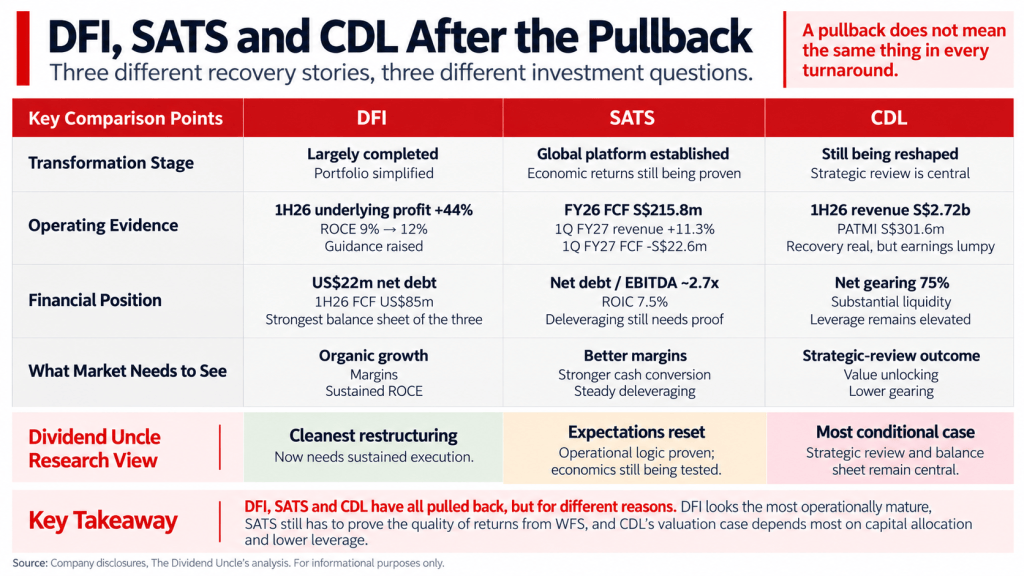
Continue reading →: Four Singapore Stocks Below Their Highs: Comparing Income Visibility, Recovery Risk and Portfolio Role
Executive Summary Singapore equities reached record territory in July 2026, with the Straits Times Index (STI) closing above 5,500 as bank-led gains compressed headline yields and intensified the sense that the market had become expensive. Yet index strength has masked significant dispersion: Singtel (SGX: Z74), Sembcorp Industries (SGX: U96), SIA…
-
Continue reading →: When REITs Sell Billion-Dollar Assets: Why Capital Recycling Matters More Than The Sale Price
Executive Summary Asset divestments are often welcomed by REIT investors for reducing leverage and unlocking capital. Yet focusing solely on headline transaction values or immediate balance-sheet improvements can obscure the more important question: whether management can ultimately recycle the proceeds into higher-quality long-term returns. Recent divestments by Frasers Centrepoint Trust…
-
Continue reading →: CapitaLand Ascott Trust: Rethinking Hospitality REIT Resilience
Executive Summary Hospitality REITs have traditionally occupied a unique position within the Singapore REIT universe. Unlike office, retail or industrial landlords that benefit from contracted leases, hotels effectively reset their revenue every day, making earnings highly sensitive to travel demand, room rates and economic cycles. This inherent volatility has historically…
-
Continue reading →: Digital Core REIT, FEHT and Sasseur REIT: Same Valuation Ceiling, Different Risks
Executive Summary Digital Core REIT (SGX: DCRU), Far East Hospitality Trust or FEHT (SGX: Q5T) and Sasseur REIT (SGX: CRPU) share one market symptom: their unit prices have remained heavily range-bound despite relatively healthy balance sheets and income yields that continue to screen attractively. The similarity ends there. Digital Core…

Independent research and analysis on Singapore-listed REITs and income-oriented investments, with a focus on long-term portfolio construction and income durability.
Read our Editorial Standards & Disclaimer ->
Welcome to ‘The Dividend Uncle’s Take’ — where I share clear, independent insights on Singapore REITs, dividend stocks, ETFs, and income-focused investing. Everything I write is grounded in my own research and real investing experience. No hype — just long-term thinking and skin in the game. Let’s grow our income portfolios steadily, one dividend at a time.
Let’s connect
Join the journey!
Stay updated with our latest articles and videos by joining our YouTube and other social media accounts.