
Executive Summary
DFI Retail Group (SGX: D01), SATS (SGX: S58) and City Developments Limited (CDL) (SGX: C09) have all experienced substantial corporate change and strong share-price recoveries, followed by meaningful pullbacks. The common question is whether those corrections signal deteriorating fundamentals or simply lower market expectations.
The evidence points to three different situations.
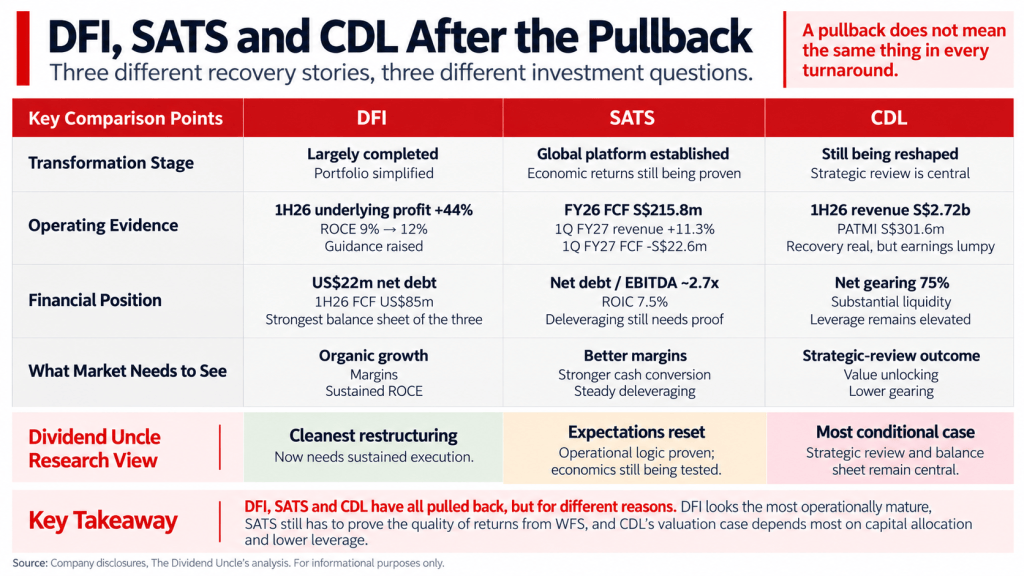
DFI has the cleanest restructuring story. Portfolio simplification has been followed by stronger operating results, higher return on capital and a near-neutral net-debt position. The main challenge has shifted from restructuring to proving that the remaining businesses can sustain organic growth and higher returns.
SATS has substantially validated the operational logic of the WFS acquisition, but not yet the full economic case. Revenue and earnings are growing, but margin compression and weaker recent cash conversion show that returns on the enlarged global platform still need to be demonstrated.
CDL has the strongest tension between operating recovery and financial risk. Property development and hotel operations have improved, but leverage remains elevated. Its 28 September strategic-review outcome is therefore the most immediate catalyst and could materially change the assessment.
| DFI | SATS | CDL | |
|---|---|---|---|
| Transformation stage | Largely completed | Platform established; economics still being proven | Still being reshaped |
| Recovery evidence | Strongest | Positive, but margins/cash conversion mixed | Strong, but earnings more lumpy |
| Financial position | Near-neutral net debt | Deleveraging still required | High leverage despite strong liquidity |
| Current setup | Execution-driven | Expectations reset | Strategic review is key |
DFI: Restructuring Has Largely Given Way to Execution
DFI’s recovery is the most advanced of the three because the major portfolio restructuring has already occurred. The group exited weaker or lower-return businesses across several markets and has emerged with a more focused portfolio centred on Health & Beauty, Convenience, Food, Home Furnishings and its associate interests.
More importantly, the post-restructuring operating evidence has strengthened.
For 1H2026, underlying profit from continuing businesses increased 44% to US$117 million, like-for-like subsidiary sales from continuing businesses grew 3%, and return on capital employed improved from 9% at December 2025 to 12%. Management also raised full-year organic revenue growth guidance to 3–4% and underlying profit guidance to US$285–305 million.
These numbers matter because DFI’s restructuring should not ultimately be judged by how many businesses were sold. The more important test is whether the capital retained in the group is now earning better returns.
The balance sheet also provides substantial flexibility. DFI ended June 2026 with only around US$22 million of net debt, while first-half operating cash flow after lease payments was US$178 million and free cash flow was US$85 million. The company is therefore no longer technically in net cash, but its financial position remains close to neutral and cash generation is healthy.
That shifts the principal risk from financial stress to capital allocation. DFI has begun making selective investments, including the small acquisition of Cody Hong Kong, which complements its growing retail-media capabilities. The transaction itself is immaterial relative to the group; the more important question is whether future investments remain disciplined and support the improving ROCE profile.
The next phase is consequently less about restructuring and more about proving that stronger organic sales, margins and returns can be sustained without another major portfolio overhaul.
SATS: Operational Logic Proven, Economic Returns Still Being Tested
SATS followed the opposite path to DFI. Instead of simplifying, it transformed itself through the acquisition of Worldwide Flight Services (WFS), creating a much larger global aviation services platform.
The operational logic has increasingly been validated. SATS now operates an extensive international network, while WFS is contributing meaningfully to revenue and earnings. FY2026 also produced an important milestone: free cash flow of S$215.8 million, demonstrating that the enlarged group can generate meaningful cash after capital expenditure and lease payments.
However, the latest quarter shows why the investment case should not yet be considered complete.
In 1Q FY2027, revenue increased 11.3% to S$1.68 billion, but EBITDA margin declined from 18.2% to 17.3%, while PATMI margin eased from 4.7% to 4.5%. Cash conversion also weakened: operating cash flow after lease payments fell to S$23.2 million and free cash flow turned negative at S$22.6 million.
This does not invalidate the WFS thesis. Working-capital timing contributed to the weak quarter, and one quarter should not be extrapolated excessively. But it reinforces the distinction between three separate achievements:
- completing a major acquisition;
- integrating it successfully; and
- earning sufficiently attractive returns on the capital deployed.
SATS has made substantial progress on the first two. The third still depends on sustained margin improvement, stronger cash conversion, higher returns on invested capital and continued deleveraging.
The share-price correction therefore looks less like a rejection of WFS and more like an expectations reset. Investors now appear to require clearer evidence that scale can translate into higher economic returns.
CDL: Operating Recovery Is Real, but the Balance Sheet Has Not Caught Up
CDL’s recovery is the least settled because operating performance has improved while financial leverage remains high.
For 1H2026, revenue rose to approximately S$2.7 billion and PATMI reached S$301.6 million. Singapore residential development was a major contributor, including profit recognition from Lumina Grand, while hotel operating metrics also improved.
The quality of those earnings requires some interpretation. Development profits are inherently lumpy, and part of the hotel improvement reflected acquisitions and foreign-exchange gains rather than purely like-for-like growth. The direction is positive, but the underlying recovery is more mixed than the headline PATMI growth suggests.
The bigger issue is the balance sheet.
After investment-property fair-value adjustments, net gearing increased to 75%, from 71% at FY2025, largely because capital was deployed into two Singapore Government Land Sales sites. The group nevertheless retains substantial liquidity, including around S$2 billion of cash and sizeable undrawn facilities.
That creates the central contradiction in the CDL thesis:
the assets and operations are improving, but financial flexibility remains constrained.
A large discount to reported RNAV is therefore not sufficient by itself to establish value. The discount becomes more meaningful only if management demonstrates a credible route to unlocking assets, improving capital efficiency and reducing leverage.
That makes the 28 September strategic review particularly important. CDL has said the outcome will address its future direction, capital-allocation framework and implementation roadmap. Any assessment before that date should therefore remain provisional.
What the Pullbacks Actually Mean
The three corrections should not be interpreted in the same way.
For DFI, the lower share price has occurred while guidance, ROCE and operating performance have remained supportive. The challenge is that much of the easier restructuring-driven value creation has already occurred; future returns increasingly depend on normal operating execution.
For SATS, the correction reflects a more demanding debate over margins and cash conversion. The enlarged platform is real, but investors are now asking how much value that scale can generate rather than whether WFS contributes at all.
For CDL, the operating recovery is offset by greater financial uncertainty. Its valuation discount is potentially significant, but the strategic-review outcome and subsequent execution will determine whether that discount represents unlockable value or simply compensation for high leverage and capital-allocation risk.
Key Risks & Mitigating Factors
DFI: The main risk is that earnings improvement becomes overly dependent on cost efficiencies or future acquisitions. This is mitigated by stronger ROCE, improving organic growth and a very strong financial position.
SATS: Margin pressure, weak cash conversion and slower deleveraging could weaken the WFS value-creation thesis. These risks are partly mitigated by continuing revenue growth, global scale and the evidence from FY2026 that the group can generate meaningful free cash flow.
CDL: High gearing, floating-rate exposure and continued capital deployment remain the principal financial risks. These are offset by substantial liquidity, valuable underlying assets, an improving residential and hotel operating backdrop, and the potential for the strategic review to sharpen capital allocation.
The Dividend Uncle Research View
The pullbacks do not provide evidence that all three recoveries have failed, but neither do they automatically create attractive opportunities.
DFI currently has the cleanest restructuring and operating evidence, although the business now needs to prove that higher returns can be sustained without relying on further restructuring.
SATS has substantially validated the WFS operating model, but the economic returns are still being tested. Margin recovery, cash conversion and deleveraging are the key indicators from here.
CDL remains the most conditional case. Operating fundamentals have improved, but leverage and capital allocation remain unresolved. The 28 September 2026 strategic review could become an important near-term catalyst, but the longer-term case will depend on whether management’s proposals translate into lower financial risk and better capital efficiency.
The broader lesson is straightforward: a lower share price matters only when the underlying business, financial risk and path to value creation have improved sufficiently alongside it.
How This Analysis Fits Within a Broader Research Framework
This article forms part of an ongoing research series examining Singapore-listed REITs and income-oriented investments through the lens of asset quality, income sustainability, capital discipline, and portfolio role. The objective is to provide structured, long-term analysis rather than commentary on short-term price movements.
Related Research
• Singapore REITs 2026 Guide
• Core–Satellite REIT Portfolio Framework
• Dividend Investing & Income ETFs — Structural Overview
Publication note: This article is intended for educational and informational purposes and reflects publicly available information as at the date of publication.


Leave a comment